 Hybrid CoachTry your own video ↗
SAMPLE ANALYSIS · SKI_SQUAT2.MOV
Your movement,
made visible.
Two findings in the reviewed strokes
- Torso finishes nearly horizontal
- Excessive starting reach
5.7-second clip · 2 complete repetitions reviewed
Saved prototype assessment · October 5, 2026
FINDING 01 / 02
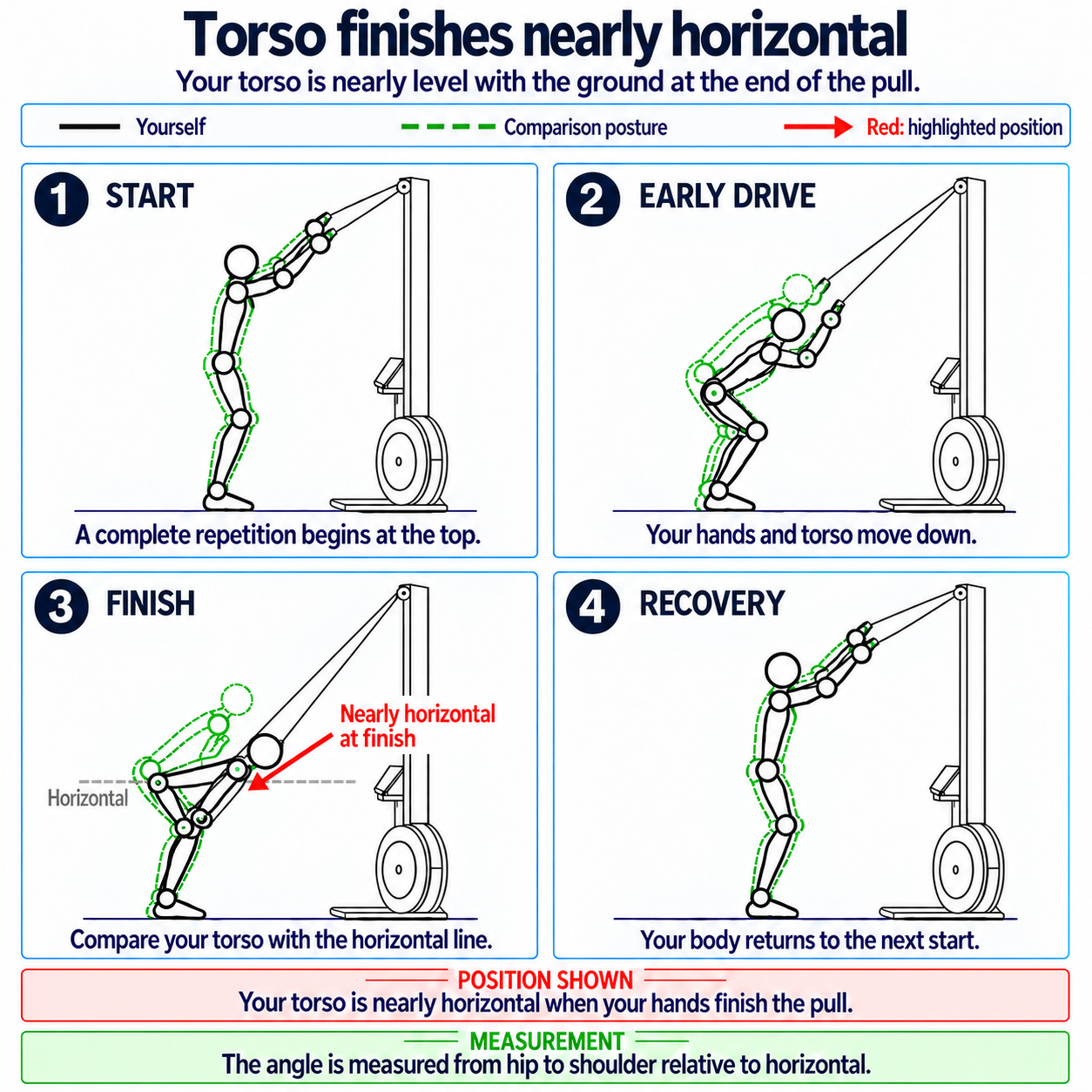
Torso finishes nearly horizontal
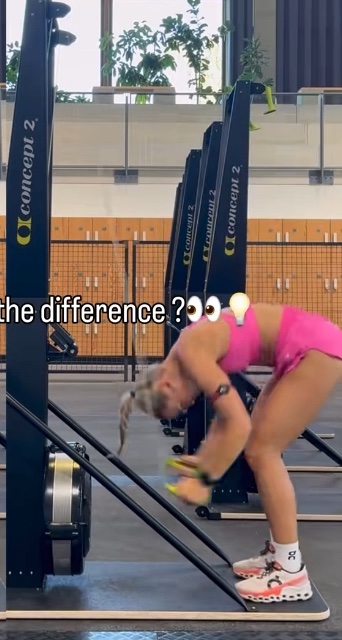
Your torso is nearly level at the finish in 2 of 2 complete repetitions.
What the analysis sees
The finish is the bottom turnaround of the hands, immediately before recovery.
This describes the visible torso position at that moment.
The torso is diagonal in other parts of the strokes.
Those positions do not replace the assessment at each actual hand bottom turnaround.
The original images support a qualitative position assessment, not calibrated anatomical measurements.
The far-side landmarks overlap the nearer side.
Observed in reviewed window 0.00–5.65s; no efficiency measurement.
Measurement details
Approximately 5° below horizontal at the finish, visible in 2 of 2 complete repetitions.
Some matching finishes were visible but their angles could not be measured reliably.
Reliable finish-angle measurements: 1 of 2 complete repetitions. The displayed angle is the median of 1 measured matching finishes. 0 finishes could not be assessed visually.
Projected 2D hip-to-shoulder angle relative to image horizontal (0° horizontal; 90° upright). Camera tilt and perspective can change this value. The near-horizontal description uses a 15° tolerance after rounding each finish to the displayed five-degree precision, not a target or a threshold for incorrect technique.
Cited moments
Angle unavailable for this frame
Angle unavailable for this frame
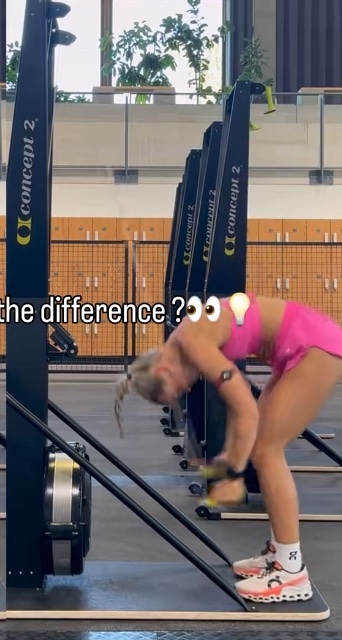
Angle unavailable for this frame
Angle unavailable for this frame
Angle unavailable for this frame
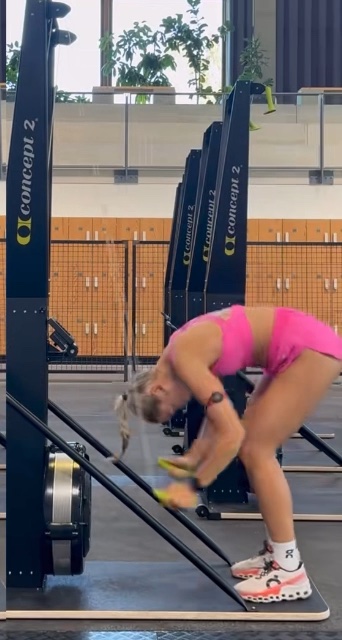
Torso ≈5° below horizontal · approximate
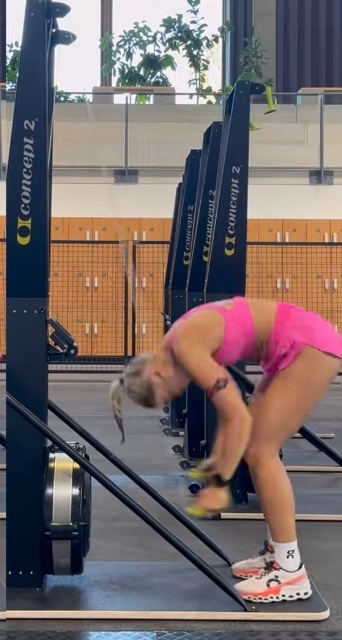
Angle unavailable for this frame
FINDING 02 / 02
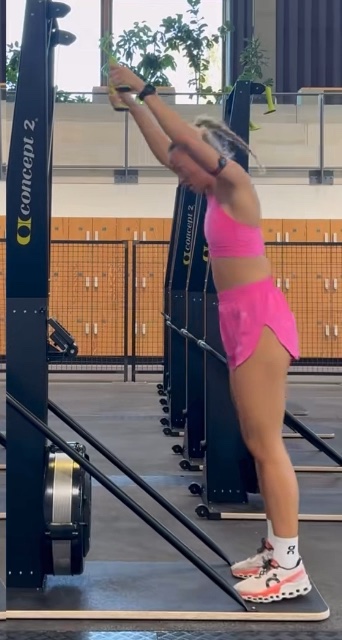
Excessive starting reach
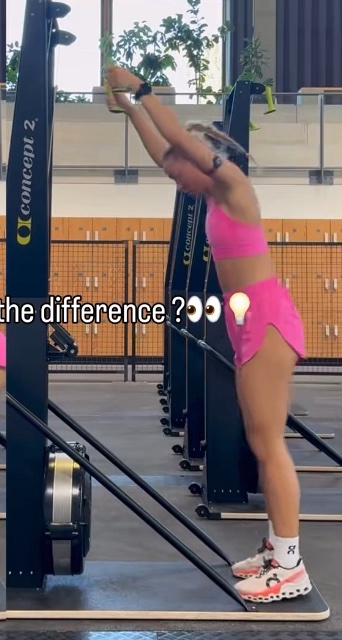
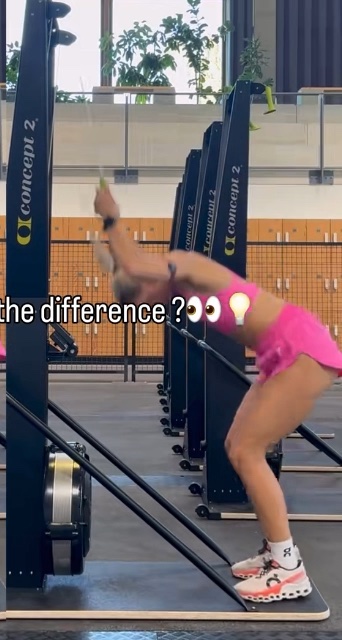
At both top endpoints, the hands are clearly above the crown and the nearer elbow is visibly open, with the arm almost straight.
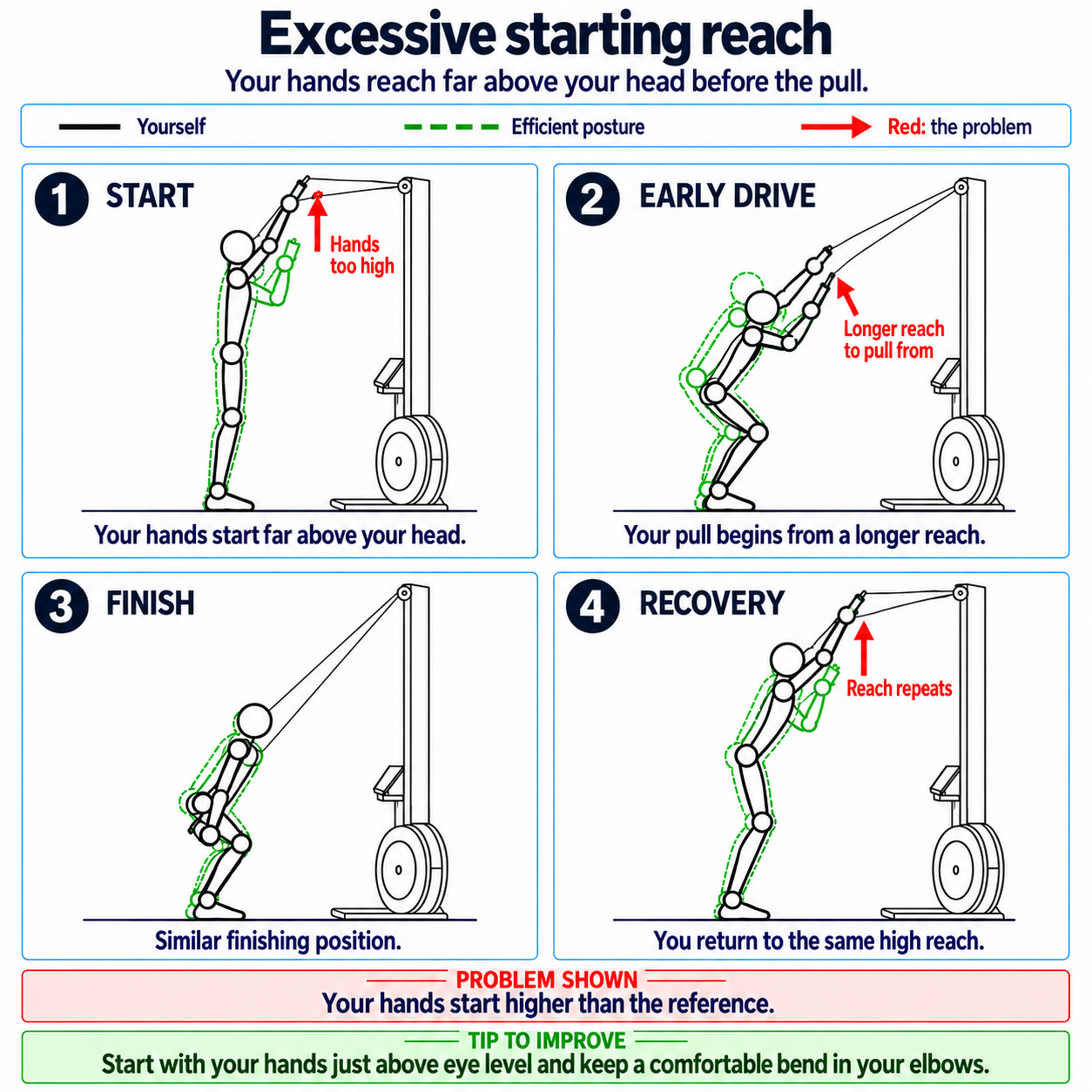
Your cue Start with your hands just above eye level and keep a comfortable bend in your elbows.
What the analysis sees
The repeated overhead endpoints and visibly open nearer elbow support the catalogue's high-reach pattern.
The hands remain forward of the head and the farther elbow has some bend.
An above-eye start alone would not support this finding; the open nearer elbow and clearly overhead endpoint are also visible.
Arm overlap limits comparison between sides.
Comfort and training intent cannot be established from images.
Observed in reviewed window 0.00–5.65s; no efficiency measurement.
Measurement details
Wrist above eye at the start: 34% of reference torso length. Starting elbow angle: 180°. Measurements available from 2 of 2 cited strokes.
These measurements describe the footage; they do not establish that this amount of movement is excessive.
Projected 2D. Joint angles: 180° straight. Torso: degrees above image horizontal. Distances: fixed reference torso length.
Cited moments
Elbow ≈180° · approximate
Angle unavailable for this frame
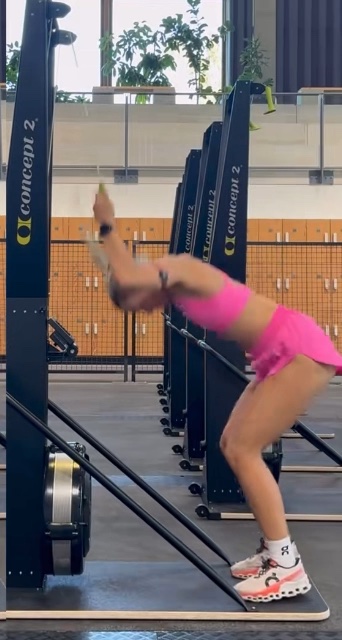
Elbow ≈110° · approximate
Elbow ≈100° · approximate
Elbow ≈110° · approximate
MOVEMENT & ANGLES
How the angles change through the clip.
Projected 2D joint angles from the saved analysis. Gaps represent unavailable measurements.

Other observations
Your knees visibly bend as your torso moves down in both complete strokes.
The head is tucked forward at the bottom of both complete strokes.
This visible posture is outside the backward-head-tipping definition.
Hair and overlapping arms limit precise facial-landmark assessment.
Movement checks
About this sample
This is the saved prototype assessment for this recording. New submissions should include at least three complete strokes.
Angles are projected 2D image measurements; camera direction changes their meaning.
Only the recorded review windows received dense AI review. Tracking covered the complete clip.
A positive observation describes a visible movement, not overall efficiency or a technique grade.